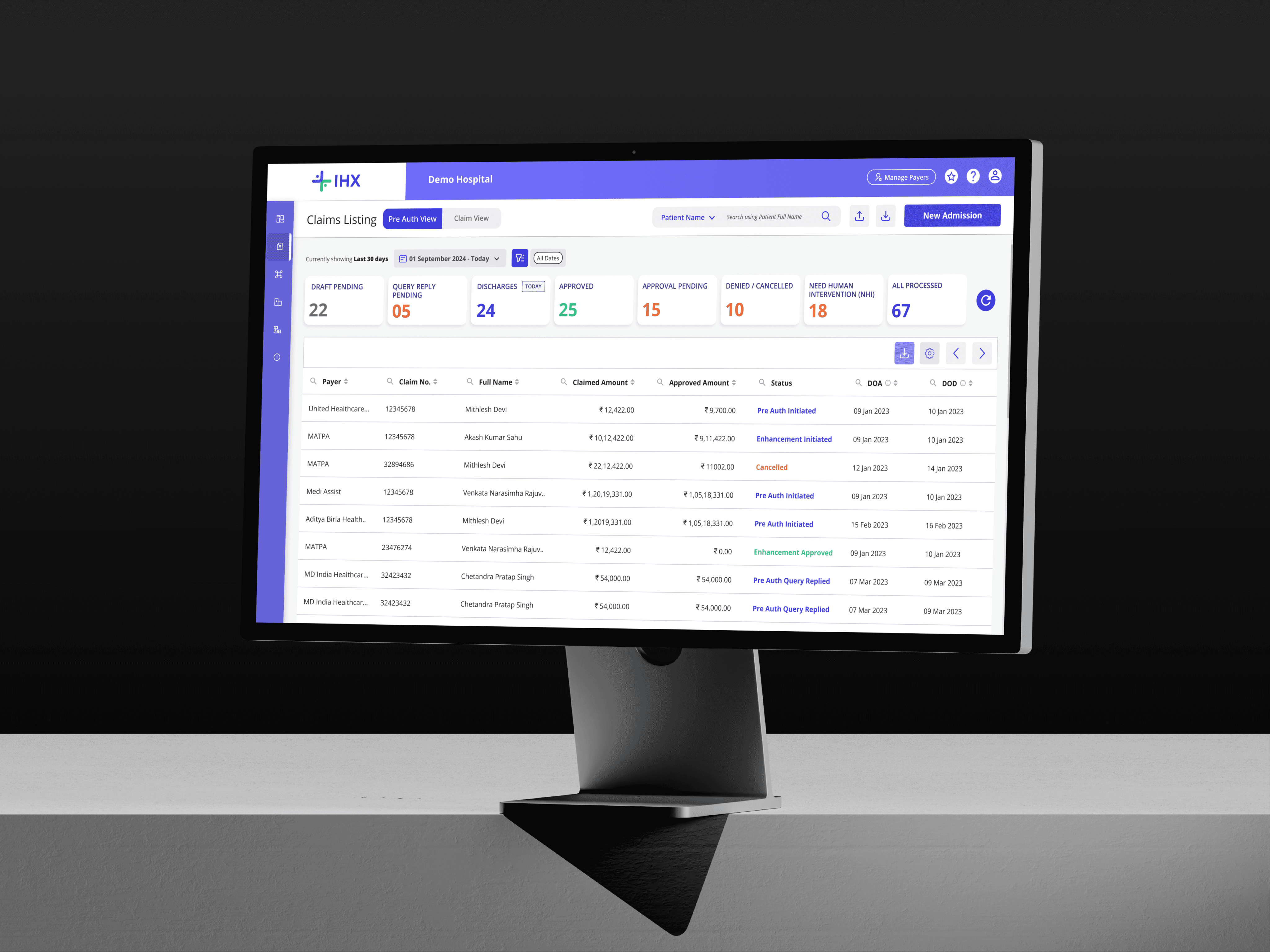
Ops Dashboard - Smarter & Faster Hospital Workflow
Ops Dashboard - Smarter & Faster Hospital Workflow
Role
Role
UI/UX, User tester, Researcher
UX Designer
Team
Team
1 Designer, 1 PM, 1 Developer
1 Designer, 1 PM, 1 Developer
Outcome
67% increase in revenue / claim
Timeframe
3 weeks
Timeframe
3 weeks
Outcome
67% increase in revenue / claim
IHX is a saas platform that allows hospitals to submit insurance claims for patients, while also enabling hospitals and insurers to track and manage claims end-to-end.

IHX is a saas platform that allows hospitals to submit insurance claims for patients, while also enabling hospitals and insurers to track and manage claims end-to-end.






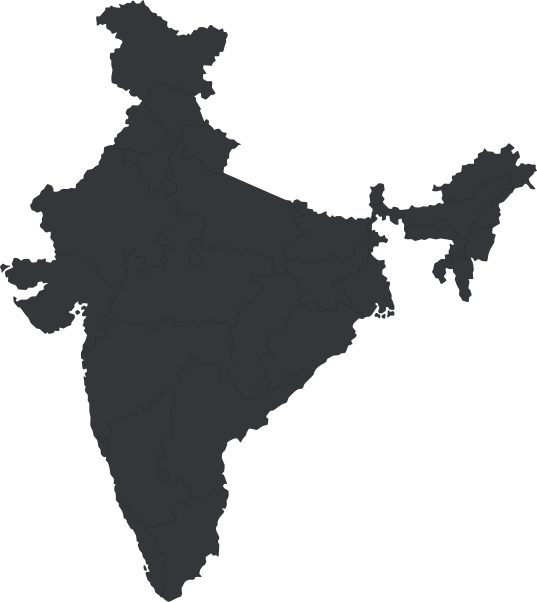
2,00,000 +
claims / month
15,000+
Active Hospitals
40%
India’s Overall Claim Volume

When the System’s Broken, It’s Bad for Business !!!
Why this matters ?
When users can’t find claims easily, it slows everything down—hurting patient care, straining hospital operations, and making it harder for IHX to retain and secure new clients
Hospital needs
An easy way to manage claims
Business Goals
Retain hospitals and secure new ones
Everybody just needs a better claim management screen !!!
1
Lack of user representation
Hospitals have two user groups taking care of the claims depending on stages.
2
Lack of actionable categorisation
Lack of actionable primary buckets and categories at stage level showing incoming queries and approvals and filtering
3
Lack of global search
Lack of global search causing users to increase time on task, increasing cognitive load and poor discoverability

1
When the System’s Broken, It’s Bad for Business !!!
Why this matters ?
When users can’t find claims easily, it slows everything down—hurting patient care, straining hospital operations, and making it harder for IHX to retain and secure new clients
1
Lack of user representation
Hospitals have two user groups taking care of the claims depending on stages.
2
Lack of actionable buckets
Lack of actionable primary buckets at stage level showing incoming queries and approvals
3
Lack of stage level categorisation
Lack of status wise secondary filters that can be filtered for quick responses by user
Real Talk : What Users Think of Our Screens
No sugar-coating, just the truth
We didn’t guess—we asked. Users shared real frustrations: unclear user roles from our end, scattered claims, and messy workflows. The problems weren’t subtle, and neither were their responses
15+
Users
15+Users
5+
Hospitals
5+ Hospitals
6+
Teams
6+Teams

“If there’s a query pending at the discharge stage, I don’t even get to know. I can’t tell my team to start working on it”
-Hospital Insurance Head






So much work! I have to keep searching for claims ready for discharge. If I miss one, patient discharge gets delayed, and seniors scolds me
-Hospital Insurance Staff 1
Our claims are all mixed up. No separate buckets for different stages. How will I know which one needs action?
-Hospital Insurance Staff 2
Our staff work in a high pressure environment, they are getting frustrated having to check each claim status manually
-Hospital Insurance Team Supervisor
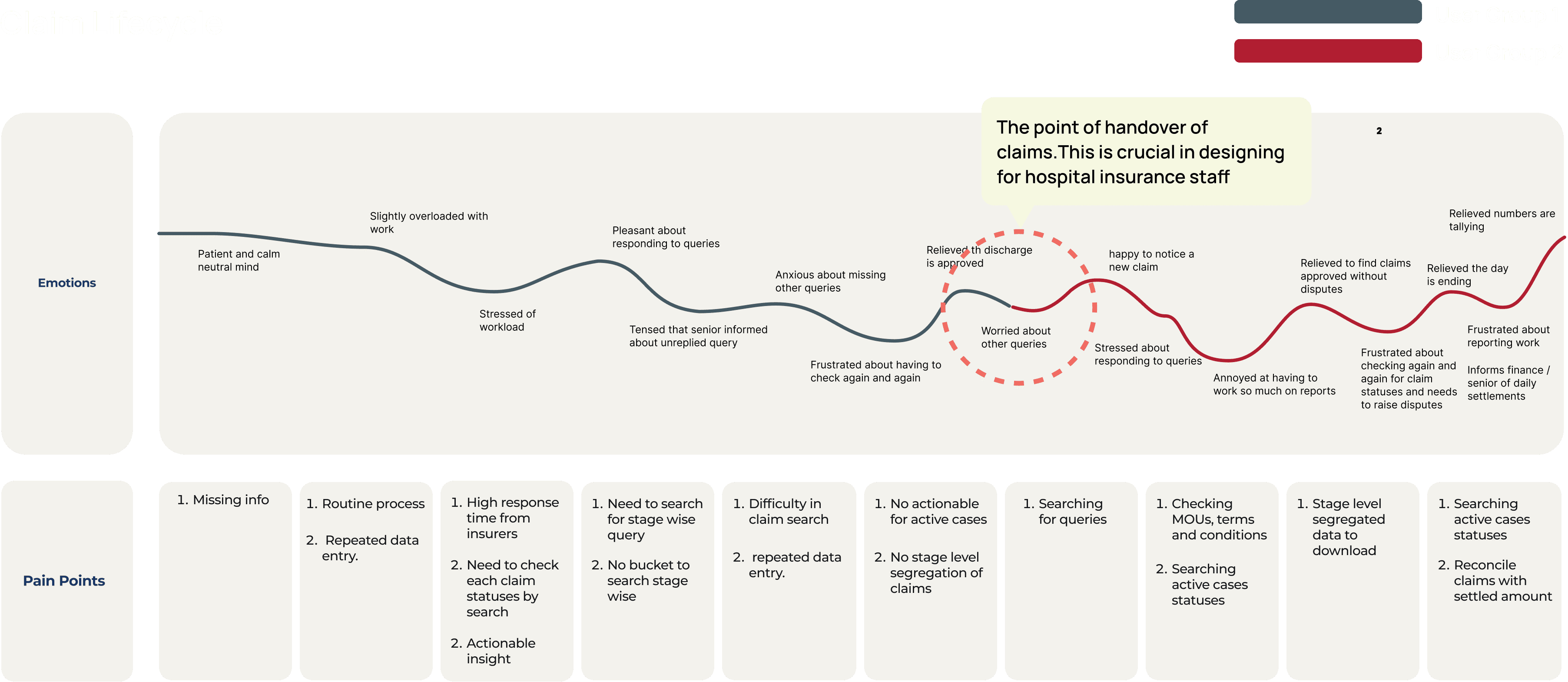
User Journey
User Journey
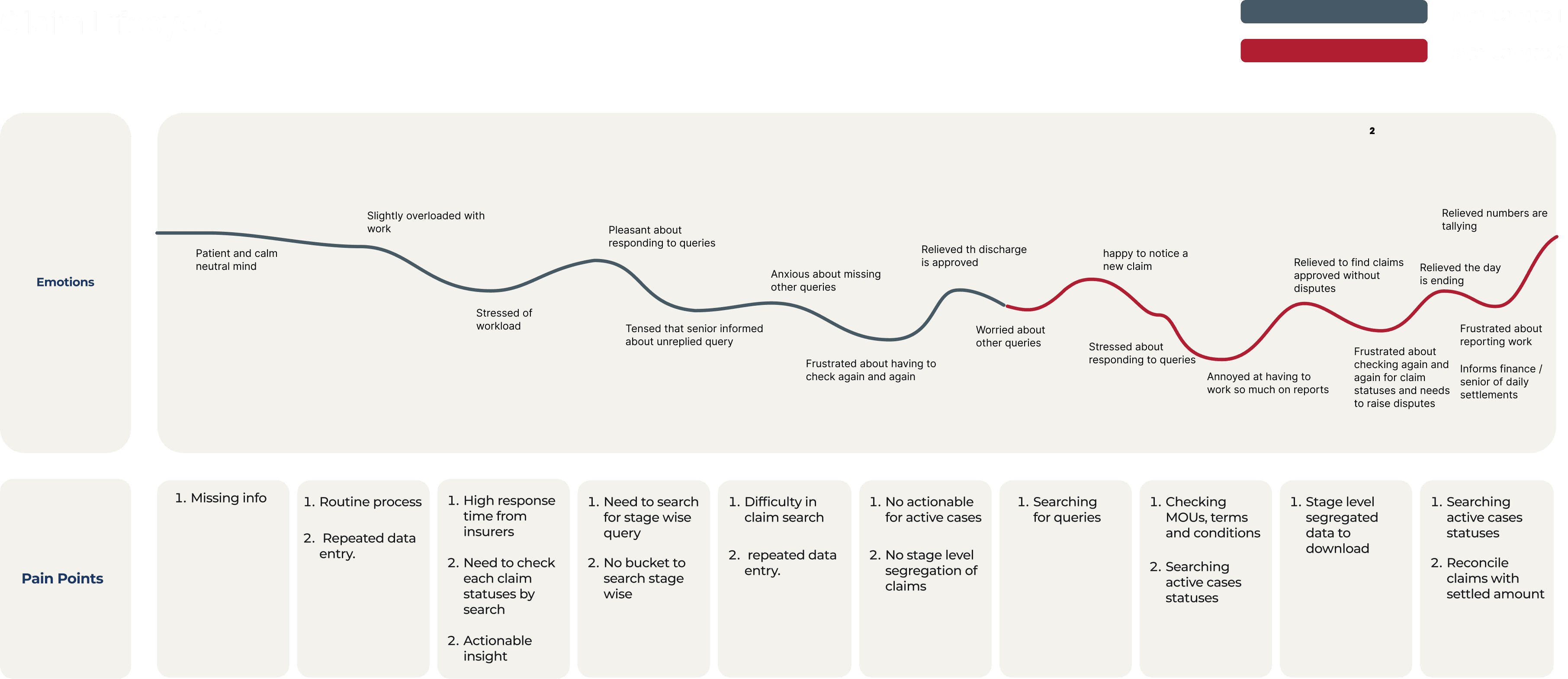
We mapped the entire claim lifecycle and discovered something crucial—the process is split between two user groups, and the handoff is where things break. That’s where we focused our design.
We mapped the entire claim lifecycle and discovered something crucial—the process is split between two user groups, and the handoff is where things break. That’s where we focused our design.
2
Real Talk : What Users Think of Our Screens
No sugar-coating, just the truth
We didn’t guess—we asked. Users shared real frustrations: unclear user roles from our end, scattered claims, and messy workflows. The problems weren’t subtle, and neither were their responses

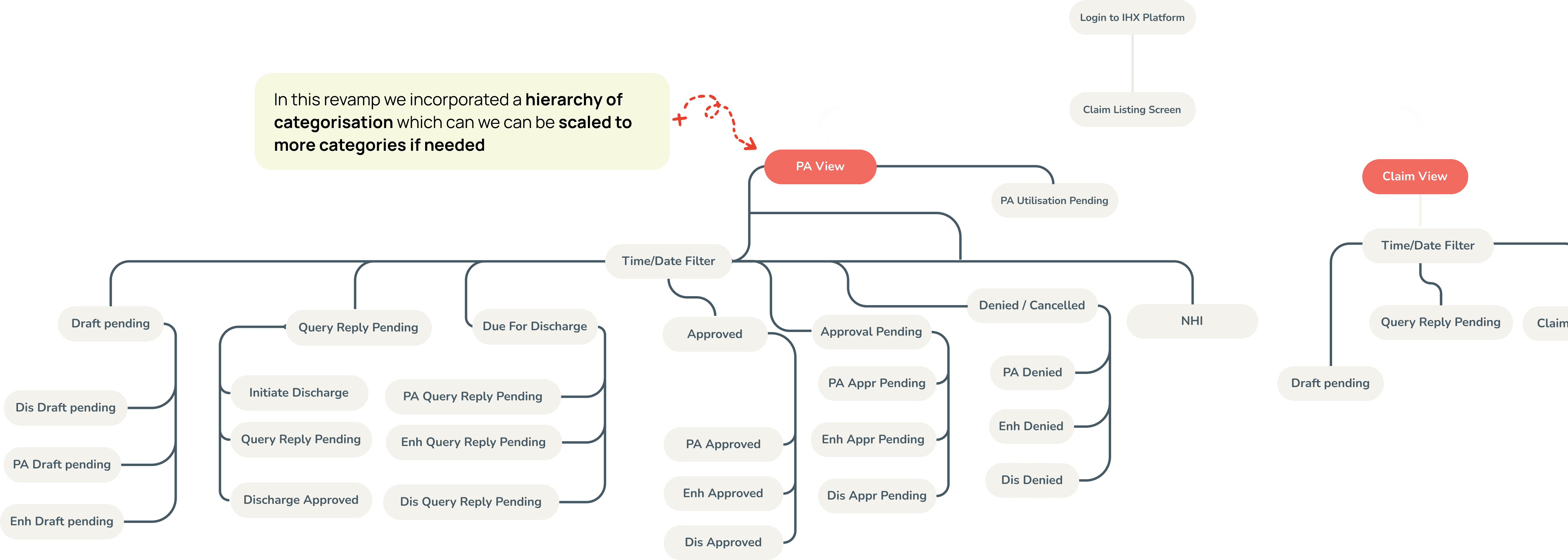
Turning Ideas into Structure, One Box at a Time
IA Revamp: we fixed the clutter
We simplified the information architecture to reflect real-world workflows. By restructuring the screen and creating action focused claim stage level bucketing, we made it easier to locate claims, act faster, and reduce confusion.
Trade offs: Scoped Search over Global Search
True global search was constrained by very large databases and high infra cost; ElasticSearch was not feasible per engineering assessment.
Analysed Google Analytics to understand actual search behaviour at the table-column level.
80%+ of searches fell into just three parameters:
Patient Name
Claim No.
UTR No.
Implemented search limited to these 3 critical parameters
Fast, reliable results with zero additional infra cost
3
Turning Ideas into Structure, One Box at a Time
IA Revamp: we fixed the clutter
We simplified the information architecture to reflect real-world workflows. By restructuring the screen and creating action focused claim stage level bucketing, we made it easier to locate claims, act faster, and reduce confusion.
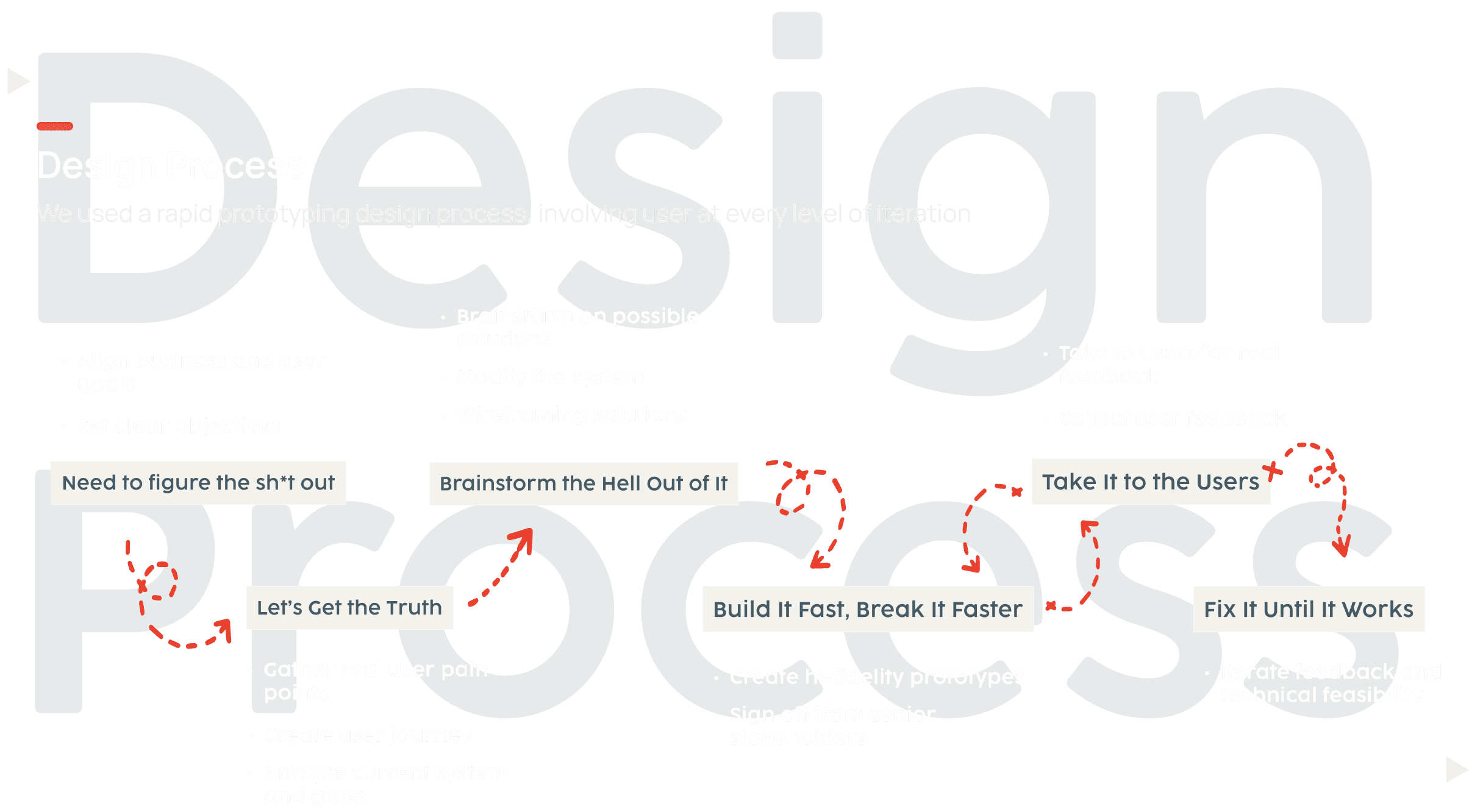
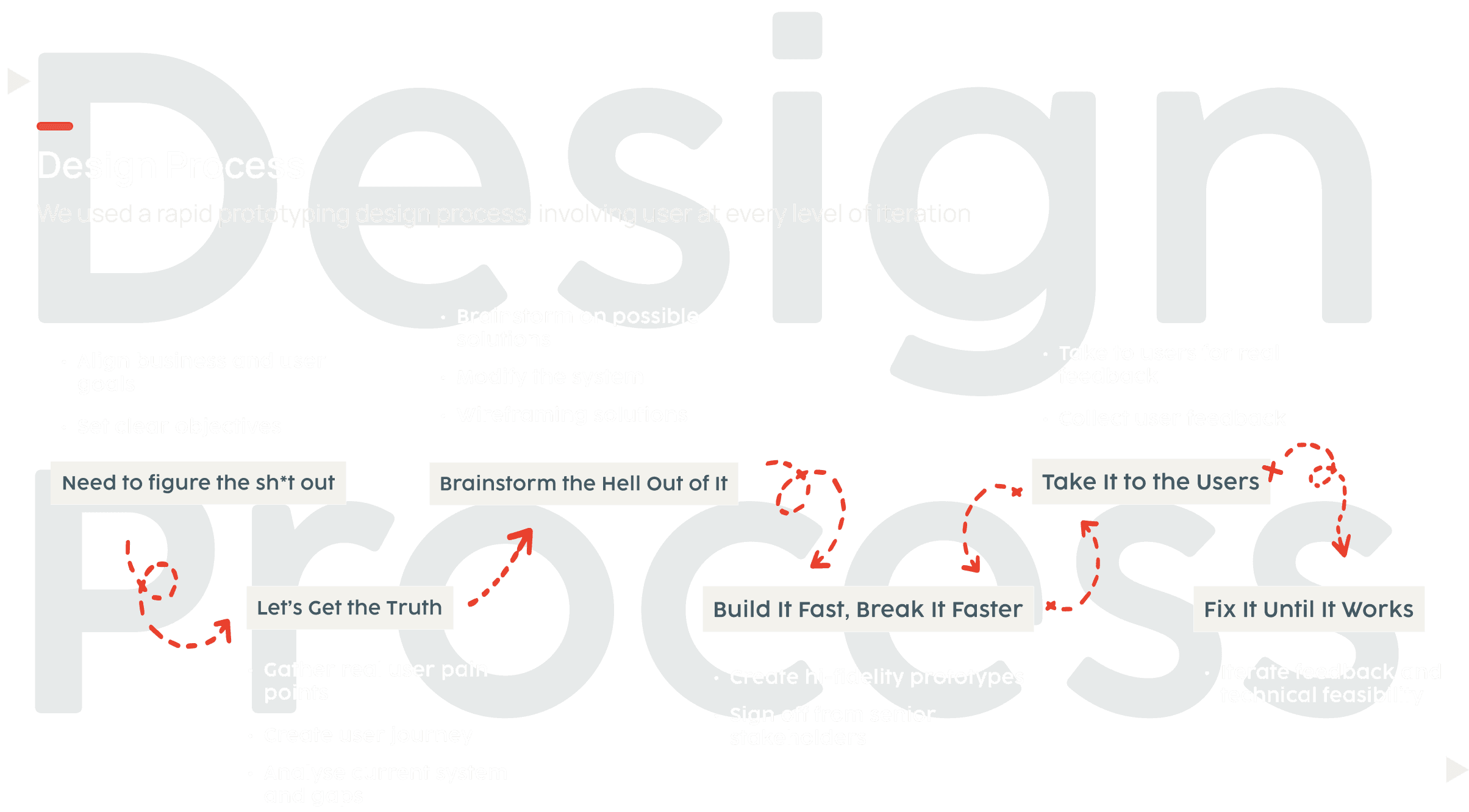
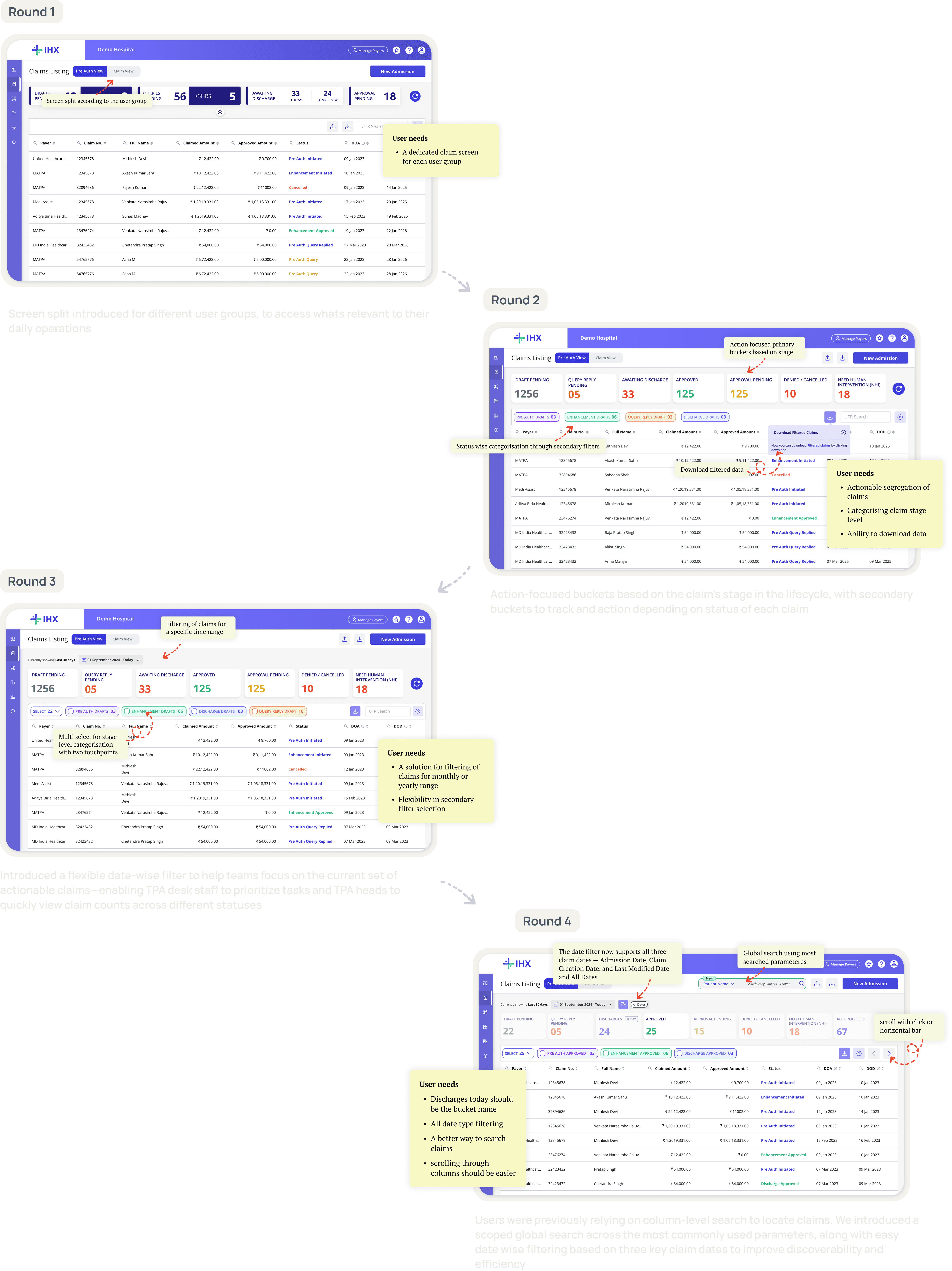
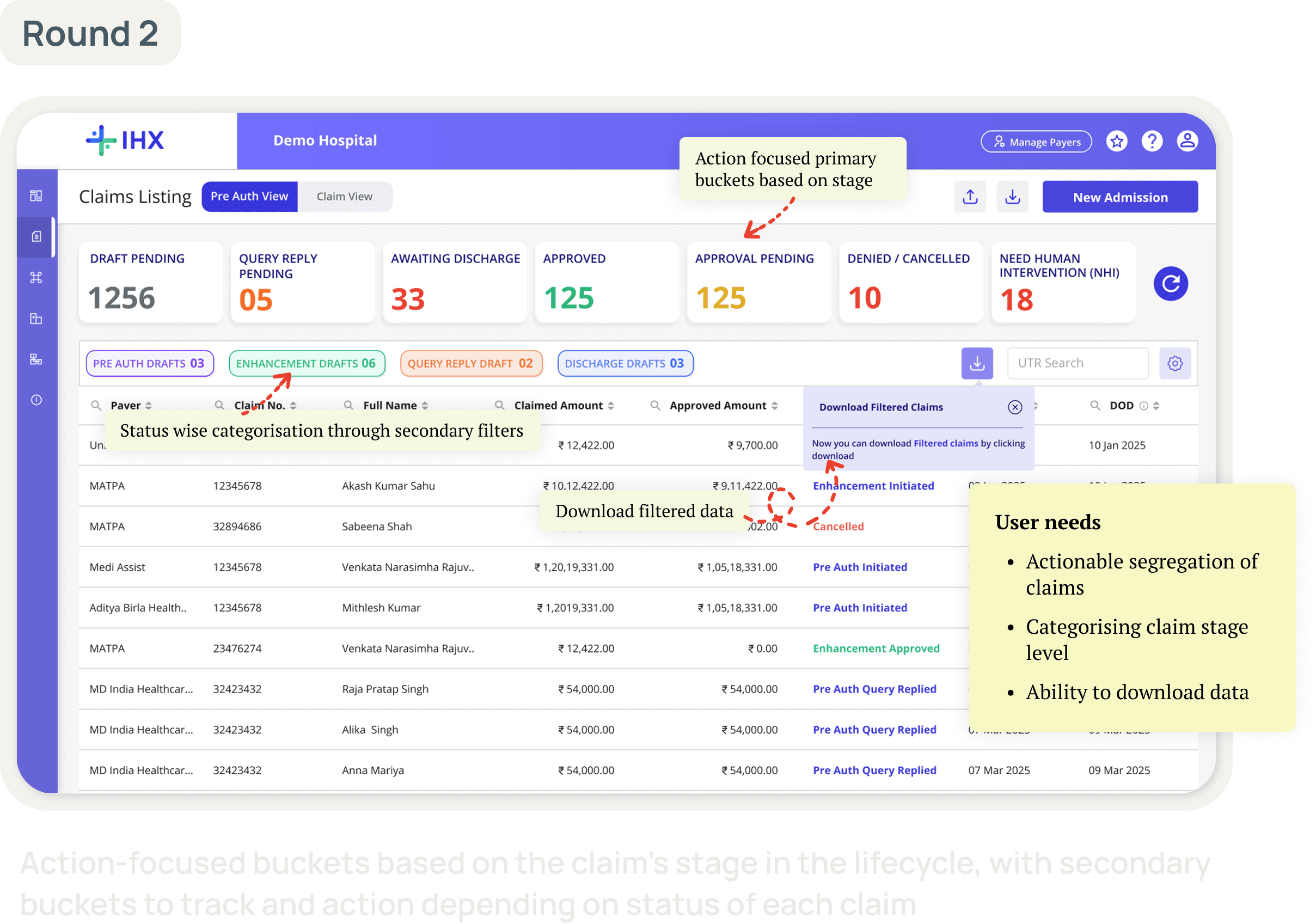
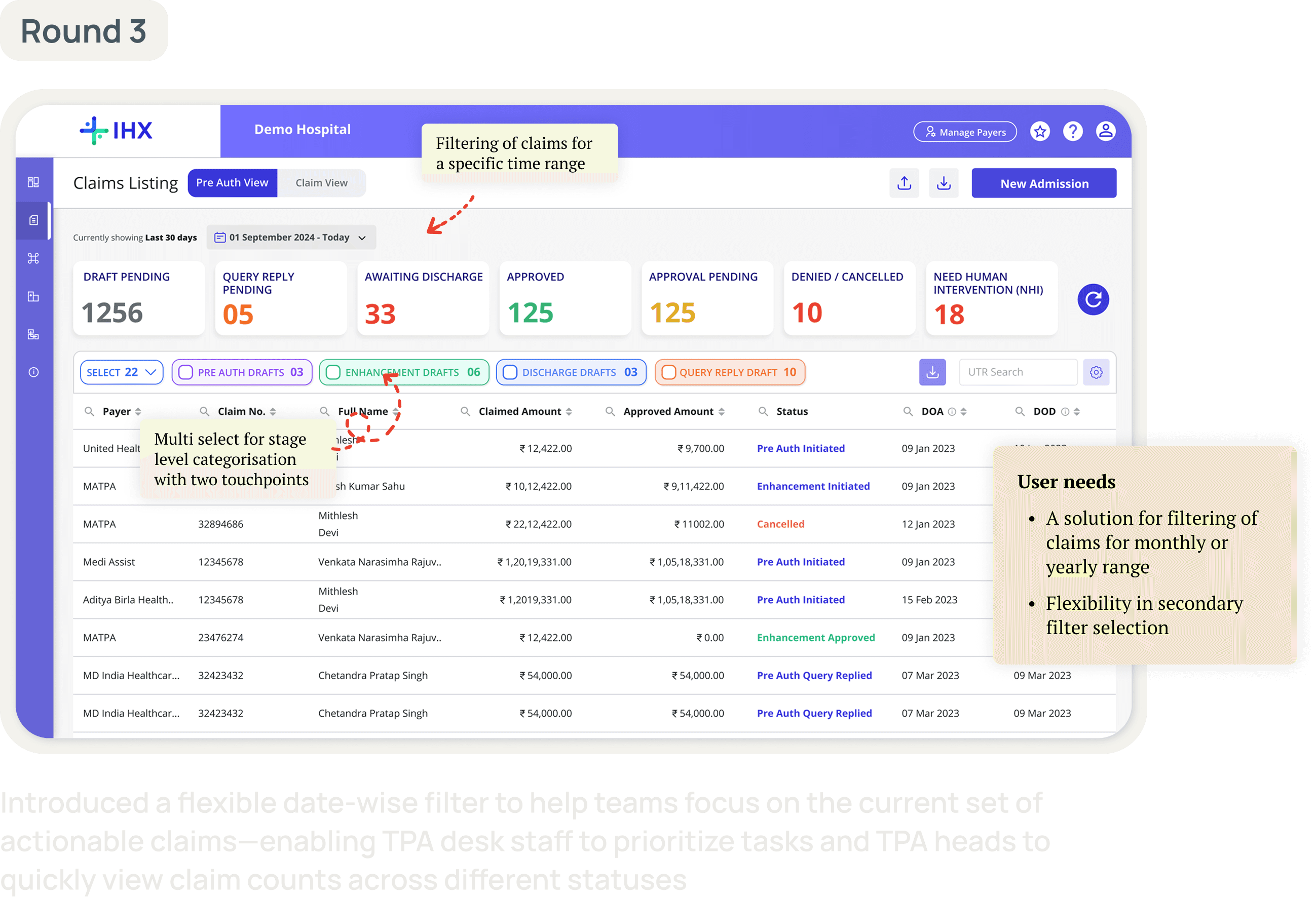
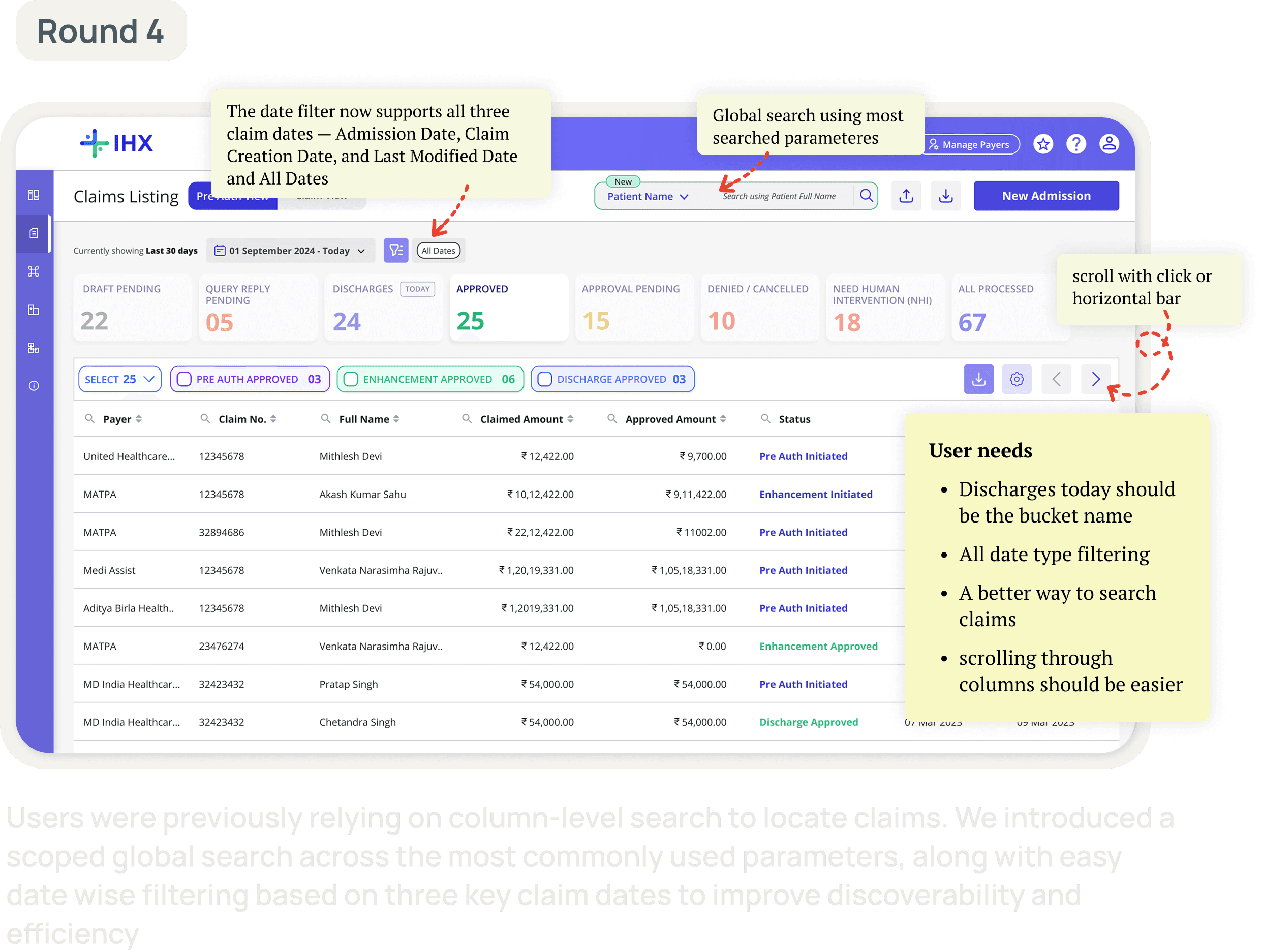
We Listen, We Improve, We test, We repeat
Make it till it works
We ran 4 rounds of testing with 2–3 hospitals each time—uncovering new pain points, prioritising what mattered to users and business, and building a product users actually want to use.
4
We Listen, We Improve, We test, We repeat
Make it till it works
We ran 4 rounds of testing with 2–3 hospitals each time—uncovering new pain points, prioritising what mattered to users and business, and building a product users actually want to use.
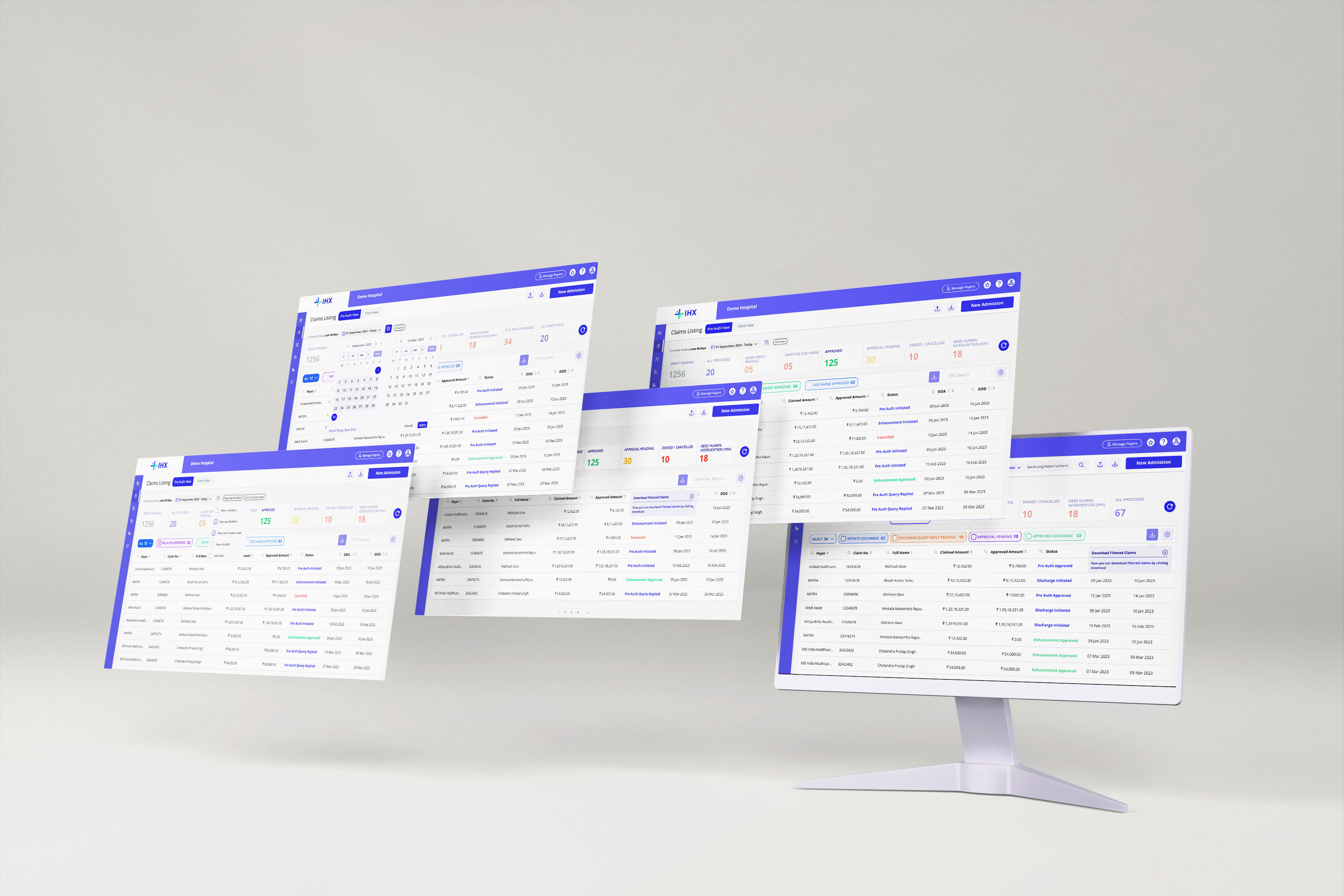
Now, Here’s How We Fixed It
Not a redesign— working, listening, and fixing what was broken.
We didn’t just patch flaws—we reworked the experience to match how hospitals actually work. One screen wasn’t enough, so we split, restructured, and involved real end users to get it right.
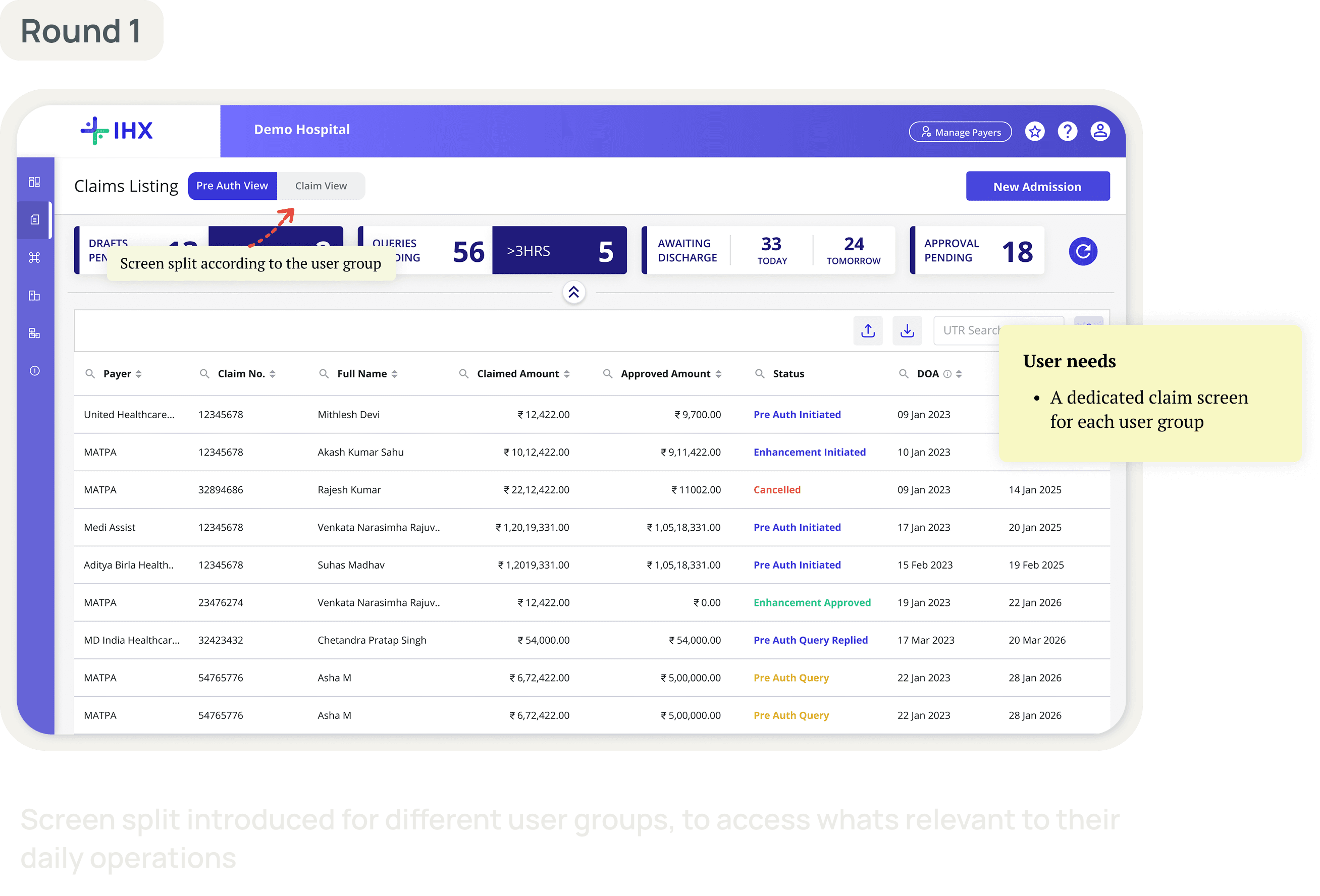
Problem 1
Hospitals have two user groups taking care of the claims depending on stages.
Claim management screens dedicated for each user group and the claim stages they handle.
We also created an easy and quick navigation between screens for a smoother user experience.
Improved collaboration between user groups through easy access to the information relevant to them.
Problem 2
Lack of actionable buckets and filtering of claims at stage level showing incoming queries and approvals
We reworked our IA and logic to focus on what really matters to users.
We created buckets for query replies pending, discharges, approvals, and cancellations/denials.
We created status-wise categorisation within primary buckets for further filtering
Problem 1
Hospitals have two user groups taking care of the claims depending on stages.
Claim management screens dedicated for each user group and the claim stages they handle.
We also created an easy and quick navigation between screens for a smoother user experience.
Improved collaboration between user groups through easy access to the information relevant to them.
Problem 3
Lack of a reliable way to search and locate claims
Introduced scoped search across commonly used claim identifiers
Reduce the dependency on column level search reducing the user cognitive load while performing search
We enabled faster claim discovery for high-volume claim lists
4
Now, Here’s How We Fixed It
Not a redesign— working, listening, and fixing what was broken.
We didn’t just patch flaws—we reworked the experience to match how hospitals actually work. One screen wasn’t enough, so we split, restructured, and involved real end users to get it right.
Problem 2
Lack of actionable buckets and filtering of claims at stage level showing incoming queries and approvals
We reworked our IA and logic to focus on what really matters to users.
We created buckets for query replies pending, discharges, approvals, and cancellations/denials.
We created status-wise categorisation within primary buckets for further filtering
Problem 3
Lack of a reliable way to search and locate claims
Introduced scoped search across commonly used claim identifiers
Reduce the dependency on column level search reducing the user cognitive load while performing search
We enabled faster claim discovery for high-volume claim lists at scale
Impact on Product: Numbers Don’t Lie.
Design that delivered
From faster task completion to a 50% boost in revenue per claim, we delivered outcomes that mattered. This wasn’t just a UI fix—it was a product win
3 Group Hospital
Contracts secured
4.6
Improved CSAT
4000+ clicks
in 10 pilot hospitals in 30 days
Increased Revenue / claim
67%
Increase in revenue per claim
Before
After
Reduced Average Time on Task
3.23 min

1.56 min
51 %
Reduction in
Avg Time on Task
Before
After
Increased Average task efficiency
34 %
Increased
Task Efficiency
Before
After
So, what did I learn ?
Understand full user journey. Don’t assume. Dive deep into the journey to capture all the frustrations and requirements before designing.
Design with Purpose, Evolve with Feedback. Test, listen, and iterate. Prioritize usability—aesthetics come second to function.
Data-Driven Decisions: Make design choices based on data, user feedback, and business goals—not just intuition.
Thank you! Your feedback is appreciated
4
Impact on Product: Numbers Don’t Lie.
Design that delivered
From faster task completion to a 50% boost in revenue per claim, we delivered outcomes that mattered. This wasn’t just a UI fix—it was a product win
3 Group Hospital
Contracts secured
4.6
Improved CSAT
4000+ clicks
in 10 pilot hospitals in 30 days
Increased Revenue / claim
67%
Increase in revenue per claim
Before
After
Increased Average task efficiency
34 %
Increased
Task Efficiency
Before
After
Reduced Average Time on Task
3.23 min
1.56 min
51 %
Reduction in
Avg Time on Task
Before
After
So, what did I learn ?
Understand full user journey. Don’t assume. Dive deep into the journey to capture all the frustrations and requirements before designing.
Design with Purpose, Evolve with Feedback. Test, listen, and iterate. Prioritize usability—aesthetics come second to function.
Data-Driven Decisions: Make design choices based on data, user feedback, and business goals—not just intuition.